Cloverdale Industries
Dead ShotCloverdale Industries is the institution that makes Statenville appear prosperous while concealing the machinery that sustains that prosperity. Founded by Deangelo Gold in 2001 as a fast-growing multilevel marketing company selling vitamins and health products, it becomes, by the time Nathan Gold is mayor, a commercial facade for a crystal-meth operation extending through the Northwest. Its significance lies not merely in the drugs produced and distributed under its name, but in the way its wealth reorganizes local government, law enforcement, employment, secrecy, and public perception around the protection of one enterprise.
Public Face and Civic Power
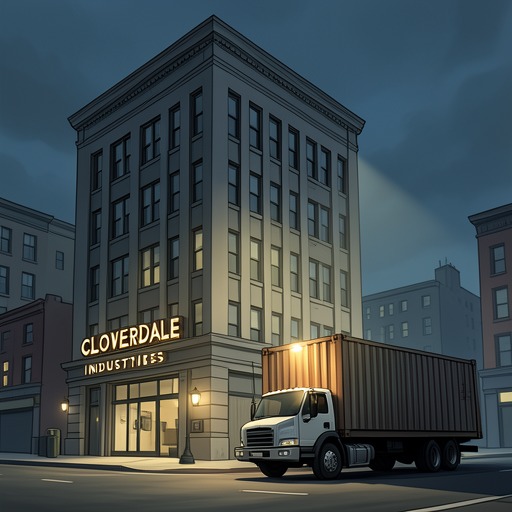
Cloverdale Industries presents itself as a legitimate business built on aspiration and consumer wellness. Its products include organic detergent, cleaners, liquid magnesium, vitamins, and other health goods, while its carefully maintained grounds project the prosperity that multilevel marketing promises to recruits. The company’s landscaping and expensive appearance are part of its sales method: the visible wealth is meant to persuade people that selling its products can deliver a luxurious life. In Statenville, that promise becomes more than advertising. It helps turn the company into the town’s major export business and makes its success appear identical with the town’s success.
That economic position gives Cloverdale Industries unusual political importance. Nathan Gold’s consolidation of the Statenville Police Department with the Brooks County Sheriff’s Department reduces the number of officers and concentrates authority, a measure that becomes popular because it saves resources while Statenville remains largely orderly. The arrangement flourishes alongside Cloverdale Industries, which turns the town into a boomtown while neighboring communities struggle during a weak economy. Gold therefore appears visionary to supporters, even as the consolidated department gives him greater control over the local enforcement system. The company’s prosperity supplies the civic justification for decisions that also make the town easier to govern from the center.
Cloverdale Industries’ influence extends into the payroll of local law enforcement. Nathan Gold places every local law-enforcement officer on the company’s cash payroll, with laundered money delivered weekly in unmarked envelopes. This arrangement does not simply buy occasional assistance; it makes official authority materially dependent on the company. The money helps Gold obtain extra help when needed and turns public servants into participants in the protection of a private criminal enterprise. The company’s apparent economic contribution thus masks a system of rent extraction in which cash, employment, and institutional access are exchanged for silence and obedience.
The Corporate Cover
The company’s central function is to make the illegal operation look ordinary. A shipment that appears to contain the cleaning product Clean and Clear instead holds a bottle filled with white crystals, an image that condenses Cloverdale Industries’ entire method: familiar packaging conceals a dangerous substance, and consumer commerce becomes the transport system for drugs. The cover is sufficiently plausible that a claim about Cloverdale Industries producing cleaning products and vitamins can sound like common knowledge while the more consequential allegation—that the facility is a commercial drug operation using multilevel marketing to hide a distribution network—remains concealed behind it.
The company’s secrecy is organized rather than accidental. Nathan Gold conducts rigorous background checks on new employees and even investigates existing workers, warning them in closed corporate gatherings that disclosure would cost them their paychecks and could send them to federal prison. The threat binds employees to the company through both fear and financial dependence. Gold’s inner circle also keeps the town’s secret from most residents, reasoning that fewer informed people mean fewer conscientious objectors who might come forward. In this structure, secrecy itself becomes a corporate resource, maintained by selective knowledge, cash, and the threat of violence.
The company’s methods also rely on distribution beyond Statenville. Drivers are instructed to travel to Seattle, Portland, and San Francisco, keeping a low profile and obeying the speed limit so that no one becomes unduly interested in the product. The instruction reveals a network that treats ordinary traffic behavior as part of criminal discipline: the shipments must look unremarkable, and restraint is safer than conspicuous speed. Cloverdale Industries is consequently both a physical facility and a regional logistics system, connecting a seemingly local business to a wider Northwest market.
Intrusion, Surveillance, and the Facility
The company’s physical plant is designed to protect the distinction between an open business and a hidden operation. When Cal Murphy and Kelly Mendoza enter through an open bay door, bright Idaho sunlight gives way to a dim warehouse that is unexpectedly sparse. The back of the building extends into darkness for at least 300 yards, leaving them with little cover and making the apparent openness of the entrance deceptive. The warehouse is not merely a workplace; under pursuit, it becomes a dangerous interior whose scale and emptiness favor the people who control it.
Cloverdale security responds as an organized defensive force. Mel Davis, head of the security operation, receives word from an executive that a man and a woman are approaching the facility and are believed to have hostile intentions. Security personnel spread through the building to search for the two suspects, converting the corporate premises into a controlled perimeter. The response shows how quickly commercial authority becomes coercive authority when the company’s secrecy is threatened.
The facility is also vulnerable to the knowledge of insiders. Walker and Mercer approach the rear of the plant using the blind spots in its camera coverage, information Walker had gathered as one of his first tasks. Because the security system is mapped from within, the company’s surveillance apparatus can be turned against it. The same access that makes an employee useful to Cloverdale Industries allows an infiltrator to move unseen, demonstrating that the company’s power depends on controlling information rather than possessing perfect control over space.
Research and the CPZ Experiment
Cloverdale Industries’ criminal operation grows more sinister when its facilities become connected to chemical experimentation. In Walker’s research lab, formulas cover dry erase boards inside a rustic room measuring roughly twenty feet by twenty feet, probably once a tack room, with dirt floors, wooden walls, and a mirror framed in an old saddle. The incongruity of the boards amid the old agricultural setting makes the room a hidden laboratory as well as a prison-like space. Kelly Mendoza photographs each formula with her iPhone and sends the images to her personal account, preserving evidence that the company’s ordinary commercial identity cannot explain.
The research concerns CPZ, a chemical marker intended to identify drug users and substantial dealers’ distribution networks. The earlier Federal Bureau of Investigation concept was to mark drugs so that unusual cases would alert the Centers for Disease Control and Prevention, allowing investigators to gather basic information about the spread of a dealer’s network. Field tests in 2008 in Seattle, Los Angeles, and Phoenix involved tainting individual doses; each drug user died, although the report did not specify the cause, and the program was abandoned. The institutional failure is therefore part of Cloverdale Industries’ later story: a discontinued federal idea survives in a private criminal setting, detached from the safeguards that had made its ethical danger visible.
Walker continues experimenting despite warnings from Mercer. The animal trials are described as horrific: monkeys nearly tear themselves apart, while dogs scratch and claw themselves to death. Officials had concluded that the theory lacked the ethical standard required for human testing, but Walker eventually mixes the marker chemical into drugs found in Riley Gold’s car. Riley is an easy target because members of the coaching staff know that some players have begun using drugs. Walker expects to observe Riley and teammates who take the substance, yet he fails to reckon with the possibility that the compound could kill them. Cloverdale Industries thus becomes associated not only with distribution but with an unauthorized experiment whose consequences reach Statenville’s young athletes.
Exposure and Collapse
Cal Murphy and Kelly Mendoza’s investigation threatens the company because it challenges the public story that Cloverdale Industries is simply a successful health-products business. Cal is an outsider reporter for The Register, and Nathan Gold understands that such a reporter is unlikely to regard Statenville as a career destination or final resting place. To Gold, the town is a temporary stop for Cal, a place from which he will move on; that assumption helps explain Gold’s confidence that the company’s curtain can remain closed. The investigation reverses that confidence by joining physical evidence, employee testimony, facility access, and the consequences of the tainted drugs.
The company’s countermeasures escalate as the investigation advances. Operation Fuego is abandoned in favor of Operation Cleanup after Gold wagers that Federal Bureau of Investigation agents have either failed to send hard evidence to their superiors or possess material that would be inadmissible in court. The change in operation names marks a shift from managing a threat to eliminating it. Cloverdale Industries’ corporate infrastructure, local payroll, and security apparatus become instruments for protecting the secret rather than conducting legitimate commerce.
The exposure finally breaks the arrangement that made Cloverdale Industries appear indispensable. Federal Bureau of Investigation officials seize control of the company and shut down operations while the bureau investigates the alleged drug-making plant. The closure reverses the company’s civic symbolism: the institution once presented as the engine of Statenville’s prosperity becomes evidence of the town’s corruption and dependence. Its lawns, health products, employee checks, security procedures, distribution routes, and hidden laboratory are reinterpreted as parts of one system in which commercial respectability served criminal power.
Cloverdale Industries therefore functions as the novel’s central architectural metaphor for controlled perception. Its visible business supplies jobs, wealth, and the language of community improvement; its concealed operation supplies drugs, coercion, surveillance, and blood money. The company does not stand outside Statenville’s political order. It helps produce that order, rewarding those who preserve it and making the town’s prosperity inseparable from the harms exported through its products. Its federal seizure is consequently more than the fall of a company: it is the forced exposure of the economic foundation beneath Statenville’s carefully managed public image.